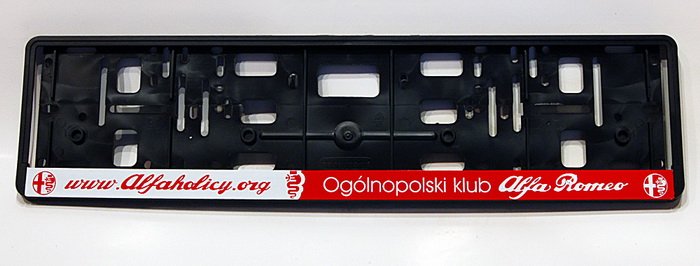
• Jeśli chcesz dodać swojej Alfie charakteru i jednocześnie zaznaczyć przynależność do naszej społeczności – to dobry moment, żeby je zamówić.

    Ramki Alfaholicy

    Szczegóły, zdjęcia oraz informacje o zamówieniu znajdziesz tutaj.

    Nie czekaj, bo jak zwykle schodzą szybko.

Chiptuning.

From what it seems from our summer meetup, you have 16" wheels on your Julka, so probably also on narrow tires 195/55R16 or 205/55R16. In that situation, after the mod I would fit wider shoes - even 225/45R17 - but then you incur additional costs of buying rims/tires and a bit higher fuel consumption. If necessary, this would have to be taken into account.
Yes, I have 16" wheels as well but width 225 :) in fact fuel economy went up a bit, something for something... , for winter I’ll switch to the factory size wheels 205/55/16 :) . Don’t overdo it with the chip, 190-200 would probably be realistic but I’m a bit held back by fear for the clutch and the dual-mass at torque around 300 Nm. The QV probably has these components adapted for higher loads (?)
 
Last edited:
I don’t know how it looks in MA, you would have to dig around either in the tuning section, or ask specialists - e.g., Cinka. By the way, the company where you did the braking - from what I read somewhere (probably even on their site) a few years ago they had some inertia brake, and then they didn’t even have that (they would send you to Silesia if someone asked). They did upload programs, so probably some ready-made ones; you can’t verify the car’s mileage without braking, and there could be issues with such work. Maybe they have a brake test again now, but they’ve put me off mods without a brake test, so I drive to Cinka because I know the guy will do the mod properly - a proven company by many forum members and over the years.
 
When I was there, on-site brake testing wasn’t available; they only had a road (dyno), and I think it’s still the case - which doesn’t mean they only flash maps without tests. From what they said, they flash maps and then modify them, testing them immediately on the road. I don’t know if this method has drawbacks - it seems to be the most natural conditions during driving; on a dyno in a chamber you never get such conditions, cooling, air resistance, etc. People probably have different opinions on this - I don’t have much knowledge or experience in this area :) Nearby there is one company, Autochip from Ostrava (actually it’s one of the branches of a fairly large network), I once considered testing them, they have very interesting programs for the Julka (standard, eco and sport) tuned, of course, individually “for the car.” I asked Cinka once (a year or two ago) but he claimed that this car couldn’t be done, I don’t remember exactly why but there was some problem - perhaps something changed in this regard
 
Last edited:
I uploaded it to YouTube, because I didn’t know what that road-dyno was. Compared to a load dyno costing about ~0.5 million PLN, that toy is... especially the tape-sticking on the fender... I’m worried how valuable it is, i.e., you probably get some glimpse and can draw some conclusions, but exact measurements can’t really be done with it. Although for diagnosing many problems, or comparisons (but not measuring) before and after the mod it might be enough.
 
I think they know what and how to do it, especially since I saw some real rally cars there. If we did measurements of one car on several stationary dynos, I’m almost sure that on each one the result would still come out different; in fact it will never be known which is closest to reality :)
 
for comparison Giulietta 1.4 after a decade, modification from a year ago
419.jpg
 
I wonder if there is any point in chipping - acceleration would probably have to drop below 7s

Sure there is a point, the engine parameters will improve, 0-100 acceleration is just one of them, you set the condition in the burner to max and change gears, and while driving it is completely different, you start from different rev speeds, different gears - after the program the torque and power will jump. The car will behave completely differently while driving.

Regarding the dyno - every dyno is as good as the person operating it.
And a dyno is not absolutely necessary to tune a car, that's the tuner’s knowledge and dynamic measurement - and this does not have to be done on rollers. Nobody can determine from what they see on a dyno whether engine parameters are okay; the lines may look beautiful, but in reality it may be junk, e.g., turbo overboost at the top - a pretty number appears, but it was produced by excess boost that should be lower in reality.
 
Sure there is a point, the engine parameters will improve, 0-100 acceleration is just one of them, you set the condition in the burner to max and change gears, and while driving it is completely different, you start from different rev speeds, different gears - after the program the torque and power will jump. The car will behave completely differently while driving.
In a weak Julka 120HP after the chip you can finally drive in higher gears - the engine gained a lot of flexibility in the useful rev band (because higher up the small turbine is still the limiter). It used to be OK for the wife, now it’s even reasonably pleasant for me, it’s not a rocket, but it drives well (torque is as much as in MA, just not in as wide a rev range, but to have more you need to change the turbine). Question is whether colleague tx555 is satisfied with what he has in MA, if yes there’s no tuning issue, if not go to a proven tuner and do it, because gains of 15-20% for such cheap money are achievable in turbo cars.

Regarding dynos - every dyno is as good as the person operating it. And a dyno is not absolutely necessary to tune a car, that’s what the tuner’s knowledge and dynamic measurement are for - and you don’t have to do this on rollers. Nobody can determine from what they see on a dyno whether engine parameters are okay; the curves can be beautiful, but in reality it can be poor, e.g., turbo overboost at the top - a pretty number but produced by excess boost that should be lower in reality.
But on the other hand, if the curves are weird, weaker, mileage/value deviates from stock, that’s a clue that something is probably not right with the engine/fuel/sensors, etc., and you should deal with that first.
 
Last edited:
Giulietta QV. Ragazzon exhaust system from start to finish. Filtration probably BMC. After modification we lowered the NM to 390 because the clutch was slipping.
132539-giulietta_qv_270km_400nm_szarpie__prycha_-giulietta_wirus.jpg
 
Question whether colleague tx555 is satisfied with what he has in MA, if yes there’s no tuning issue, if not go to a proven tuner and do it, because gains of 15-20% for such cheap money are achievable in turbo cars.
I’ll say this, generally I don’t lack power - Julka 1.4MA is quite agile and fast and perfectly enough for daily driving. Power above 200 HP and torque of 300 available probably only on a track but Julka isn’t really suited for that (any) because you can’t disable VDC - problem - maybe not on every track but certainly on one with lots of tight corners. Most cars on the road the Julka MA handles calmly, of course there will always be some that you can’t handle but that’s normal - that will always be the case, regardless of how much we have under the hood - obviously that isn’t the point :)

Sure there is a point, the engine parameters will improve, 0-100 acceleration is just one of them, you set the condition in the burner to max and change gears, and while driving it is completely different, you start from different rev speeds, different gears - after the program the torque and power will jump. The car will behave completely differently while driving.

Regarding the dyno - every dyno is as good as the person operating it. And a dyno is not absolutely necessary to tune a car, that's what the tuner’s knowledge and dynamic measurement are for - and you don’t have to do this on rollers. Nobody can determine from what they see on a dyno whether engine parameters are okay; the curves can be beautiful, but in reality it can be poor, e.g., turbo overboost at the top - a pretty number but produced by excess boost that should be lower in reality.

I agree - there’s no point relying on charts and digits, but on how the car drives on the road, so I think a quite sensible way to achieve what we want is tuning and testing changes directly on the road because that’s its natural conditions that account for everything exactly. Measurements of acceleration, elasticity, that’s what we need for daily driving and not a pretty chart with lots of HP :). I once tested for one company in my TS a fuel modifier, on dyno charts the improvement was small but the car’s behavior on the road was dramatically different, which was confirmed by elasticity measurements.

I think if I decided to mod it would be somewhat the culmination - first do intake, exhaust and then tune it all with appropriately modified maps, but I’m a bit afraid of the clutch and dual-mass—would prefer not to have to replace them at intervals like the timing belt ;). And I’d forget the most important thing - the suspension! Must happen! For me the stock is definitely too soft for fast driving, springs from the sport package would have to be installed and if that’s not enough maybe some shocks too. And it turns out it won’t be so cheap, but one change leads to another and it’s not as cheap as it might seem initially ;)
 
Last edited:
Let’s remember though that most exhaust and intake modifications increase engine noise, and not everyone who wants more power also cares about sound impressions.
Chip tuning usually means squeezing reserves left by the "average driver" who has never heard of turbine warming and cooling (Giulietta e.g., this car is loved by women, and mine has been told not to rev up from cold ;) ). If we remember a few rules there is no need to worry about engine durability and the driving experience after a "chip" is priceless (I previously had a TDI tuned from 350 to 415 Nm).
 
I’ll say this, generally I don’t lack power - Julka 1.4MA is quite agile and fast and perfectly enough for daily driving.
so there is no topic

I agree - there’s no point relying on charts and digits but on how the car drives on the road, so I think a quite sensible way to get what we want is tuning and testing changes directly on the road because that’s its natural conditions that account for everything. Measurements of acceleration, elasticity, that’s what we need for daily driving and not a pretty chart with lots of HP :).

after a chart basically you can see everything - in the 159 I had a hole in the torque curve around 2600 rpm and on the road you could feel it and it annoyed me - Cinek nicely tuned it for me and when the dyno chart was flat there were no noticeable holes in acceleration.

besides that the level/flatness of torque in the usable rev range simply shows how flexible the car is in daily use

I think that if I decided to go for a mod it would be a kind of culmination of the whole thing - that is, first do intake, exhaust and tune all of it, and only then properly modified maps at the end, just a bit afraid of the clutch and dual-mass flywheel - I’d rather not have to replace them in such intervals as the timing belt ;). And I would forget the most important part - the suspension! It’s a must! For me the stock is definitely too soft for fast driving, springs from the sport package would have to be installed and if that’s not enough perhaps some shocks as well. And it turns out it won’t be so cheap after all, but that’s how it goes, one change pulls another and it’s not as cheap as it might have seemed at first ;)

you would go for a rally car right away. most people don’t want that - simply what the factory gave (especially if we’re talking about the 120HP TB) is just a bit too little. With the MA I might not even think about a chip.
 
Power over 200HP and torque of 300 available probably only on a track but that car isn’t really suited for that

But this isn’t about flooring the accelerator to the floor, only about the fact that in everyday use a "more capable" engine will make it easier to move on the road. An increase in torque will help with overtaking, acceleration, improve the car’s "flexibility". Instead of pushing the gas hard, you just touch it and the car will go much brisker than before. And on the highway you can never have too much power, in my Julie MA I felt a lack of it especially when accelerating after coasting.
 
But this isn’t about flooring the accelerator to the floor, only about the fact that in everyday use a "more capable" engine will make it easier to move on the road. An increase in torque will help with overtaking, acceleration, improve the car’s "flexibility". Instead of pushing the gas hard, you just touch it and the car will go much brisker than before. And on the highway you can never have too much power, in my Julie MA I felt a lack of it especially when accelerating after coasting.

exactly, after modification you don’t necessarily drive faster (well, maybe sometimes), generally you gain a reserve that in situations like overtaking or highway driving comes in handy.
 
And I’d like to ask whether D and N modes use the same map and whether the difference in torque is due to opening/closing an extra blow-off valve in the turbo (that’s what I read somewhere)? I’m wondering if it’s possible to modify the map only for D mode? Leaving N mode unchanged? In everyday city driving the stock N mode is more than enough for me. But sometimes on the road, especially on highways, those 20-30 HP more would be nice.
 
And I’d like to ask whether D and N modes use the same map and whether the difference in torque is due to opening/closing an extra blow-off valve in the turbo (that’s what I read somewhere)? I’m wondering if it’s possible to modify the map only for D mode? Leaving N mode unchanged? In everyday city driving the stock N mode is more than enough for me. But sometimes on the road, especially on highways, those 20-30 HP more would be nice.

According to measurements on a dyno, there is no difference between D and N. The difference is in reaction to the throttle + (with TCT) the way gears are changed. Apparently :) I was surprised too when I heard that.
 
I’ve also heard that, although the difference between N and D seems larger than what would result only from changes in throttle response, I have the impression that torque curves also change. But you can’t measure it on a regular dyno in D mode because the immobile rear wheels cause ABS error and the car shifts into N (I don’t know who measured it). Chiptuning covers all modes, you can’t flash Julka separately for N and D, and interestingly apparently in Punto EVO with the same engine this is possible.
 
From the plot you can see almost everything - in the 159 I had a torque hole at about 2600 RPM and on the road you could feel it and it annoyed me - Cinek dialed it in nicely and when the dyno plot was flat there were no noticeable holes in acceleration. besides that the level/flatness of torque in the usable RPM range simply shows how elastic the car is in everyday use
yeah, I understand and don’t deny it - surely the dyno plot shows a lot (especially with turbo) but the results from a roller dyno should be treated here as a reference point during tuning. Still it won’t fully reflect how the car behaves on the road where air resistance (CX coefficient) is very important, not to mention the different behavior of the engine on individual gears, turbine surge etc. If I remember correctly the car brakes in only one gear on probably one gear.
you would go for a rally car right away. most people don’t want that - simply what the factory gave (especially if we’re talking about the 120HP TB) is just a bit too little. With the MA I might not even think about a chip.
it’s not about a rally car but about the normal behavior of the car on the road (not necessarily on the highway) if we want to use these possibilities after a chip. 200HP 300Nm (or more) in a Julie with standard suspension is a mismatch and form over function, such a car won’t drive well and I’m not saying it will just cruise along :). Even stock it’s hard to fully exploit MA engine capabilities due to system interventions and too soft suspension. Of course with lower power (e.g., mod from 120 to 145HP) you can skip it—I agree that it isn’t necessary. By the way, I really dislike when the hood pops up after hitting the gas, I prefer power and torque to be transferred to the wheels rather than into the air ;)
P.S. for the record - there are curves where the AR146 120HP used to take my curves much faster than the current Julie MA, here more power and torque won’t help in that situation- but what to do when you can’t get rid of a prosthetic :(
 
Last edited:
Amortyzatory
Back
Top