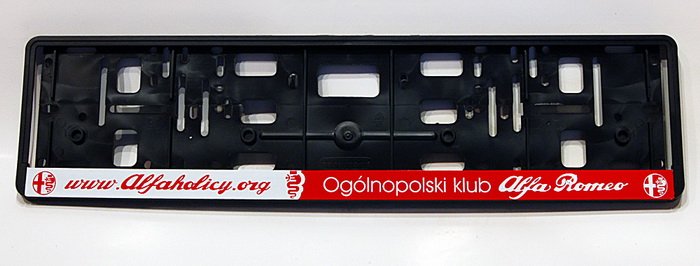
• Jeśli chcesz dodać swojej Alfie charakteru i jednocześnie zaznaczyć przynależność do naszej społeczności – to dobry moment, żeby je zamówić.

    Ramki Alfaholicy

    Szczegóły, zdjęcia oraz informacje o zamówieniu znajdziesz tutaj.

    Nie czekaj, bo jak zwykle schodzą szybko.

Collisions

and practically all of that energy will be taken up by the crush zones of both cars.

I have a question, let’s imagine an undeformable obstacle that we split the road with across it.
On one side a car A is driving, on the other side car B, exactly the same (same mass, speed, physical properties of the body and chassis)
They hit the obstacle at the same time.

(we assume the obstacle does not move)

Does this situation differ from a frontal collision in a situation where there was no obstacle, and the cars would crash into each other perfectly, centrally frontally?

What do you think? ;)
 
Last edited:
That’s exactly what I meant. I’ve never watched MB.
but you wrote differently that they don’t add up :)


But don’t forget that in a car-to-car crash (assuming the same mass and speed), we have two times the kinetic energy that we have to dissipate.
but it distributes over two cars and that’s exactly what I’m talking about

The wall of kinetic energy doesn’t exist.
exactly, only that then the car loses all of it

Mythbusters and in general certain comments in human consciousness are that speeds don’t add up - they do, like crazy, you just have to consider how energies are dissipated (who dissipates them), besides masses, it’s hard to classify car crashes into certain types of ideal collisions, and there are also different directions of velocity, for example.

if we consider collisions of similar cars going in the same direction, for example
a collision of cars (assume identical) moving toward each other at 100 km/h is the same in effects/overloads etc) for both as if one stood still and the other crashed into it at 200 km/h - the speeds add, energies distribute evenly between both cars!
natomiast if a car goes 100 km/h and hits a wall, it has effects exactly the same as if it collided traveling 200 km/h into a stationary car. The kinetic energy at 200 km/h is 4 times bigger than at 100, but don’t forget that hitting a stationary car causes the cars after the collision to continue moving at half the speed and with double mass (principle of momentum conservation), so half of that 4-fold kinetic energy remains as motion of both cars, and the other half (double of what if one car went 100) distributes between both cars equally (half of that half), so in the end 100 into a wall is the same in effect as 200 into a parked car, with the difference that the latter still causes motion of both vehicles onward.

I recommend thinking this through, and maybe work out a few examples on paper if anyone gets bored :)
 
Speeds don’t add up, so there wouldn’t be a bigger difference. Peterr - probably, two different worlds, but even from an old Omega at that speed there was quite a bit left, the passenger compartment isn’t crushed to bits; so IMHO this Stelvio could have been 190 on the speedometer at the moment of impact.

There is a difference and it is very big. In the video an Omega weighing about 1500 kg at 200 km/h (about 55.5 m/s) hits another stationary car. The kinetic energy that this system has before the collision is only that resulting from the Omega’s motion, about 2310 kJ. However, during the collision the kinetic energy is transformed into the motion of all bodies (after the crash they move) and the work that was done to crush them.

In an accident Stelvio and Galaxy, we have two moving cars. Assuming speeds around 150 km/h (about 42 m/s) and masses Stelvio - 1660 kg, and Galaxy 1800 kg (masses from Wiki), we have energies respectively 2930 kJ and 3175 kJ, i.e. in total about 6000 kJ, which also have to be dissipated, whether into moving both bodies after the collision or energy absorbed by crumpling bodywork, heat, etc.
 
Last edited:
and practically all of this energy will be taken up by the crush zones of both cars.

I have a question, let’s imagine an undeformable obstacle that we split the road with across it.
On one side a car A is driving, on the other side car B, exactly the same (same mass, speed, physical properties of the body and chassis)
They hit the obstacle at the same time.

(we assume the obstacle does not move)

Does this situation differ from a frontal collision in a situation where there was no obstacle, and the cars would crash into each other perfectly, centrally frontally?

What do you think? ;)

If you assume that the obstacle is undeformable, non-movable such that both collisions do not interact at all, keeping all conditions i.e. mass, speeds, etc. - then in the ideal case, where both cars after the collision come to rest as one “pile of sheet metal,” it doesn’t differ much.
 
If you assume the obstacle is undeformable, non-movable, such that the two collisions do not interact in any way with each other, while keeping all conditions i.e. mass, speeds, etc. - then in the ideal case where both cars after the collision come to a stop in place as one "pile of sheet metal" it doesn’t differ much.
What has this come to:D I’m starting to regret that I paid attention in physics:)

Sent from my SM-N950F using Tapatalka
 
But don’t forget that in a car-to-car collision (assuming the same mass and speed), we have twice the kinetic energy that we must dissipate. The wall of kinetic energy does not possess it.

If the car moves toward the wall with speed V, then from the driver's point of view the wall has kinetic energy equal to (mass of the wall * V^2)/2. I don’t know where the idea that it has no kinetic energy comes from...
 
Last edited:
If the car moves toward the wall with speed V, then from the driver's point of view the wall has kinetic energy equal to (mass of the wall * V^2)/2. I don’t know where the idea that it has no kinetic energy comes from...

And I don’t know where the idea of suddenly changing the reference frame comes from... Let’s stick to one frame of reference, and not jump between them arbitrarily.

We adopt a Earth-related reference frame, and here the car has speed V, and the wall speed equal to 0. So where does kinetic energy come from in the case of a stationary wall?
 
Last edited:
Not in this reference frame!
According to your claim, the car moves toward the wall at speed V, and the wall toward the car also at speed V, so the closing speed is 2*V...

You cannot change reference frames in one description of motion, because nonsense like above results.

Example:
If in a large room you run toward the wall, relative to the room the wall is at rest and you approach the wall.
But relative to you the room moves and the wall approaches you, only you remain at rest in this frame.

If you claim that in the same reference frame you approach the wall and at the same time the wall approaches you, it turns out that you running toward the wall at speed V approach it at 2*V, because it is also running toward you.

- - - Updated - - -

I don’t know how to explain it more simply, so I’m dropping a quote from the page www.fizykon.org

Inertial frame of reference - what is that?
An inertial frame is most often tied to some material object (though in principle a strict connection to a body is not absolutely necessary) and defines what we mean by rest. In its own frame, the frame itself remains at rest - since nothing moves relative to itself.

For example, a frame can be tied to the Earth. In this frame the Earth is at rest, and all objects moving relative to it are in motion. A flying plane (and its seats mounted to the plane), a braking car, a flying fly will be in motion relative to Earth. In rest with respect to Earth will be a house, or a mountain on that Earth.

However we can tie the frame of reference to something else – e.g. to a flying plane. In the frame related to the plane, the Earth, house, and mountain are in motion; but the plane itself, its seats, cockpit, fuselage and sleeping passenger remain at rest.
 
Last edited:
If the car moves toward the wall with speed V, then from the driver's point of view the wall has kinetic energy equal to (mass of the wall * V^2)/2. I don’t know where the idea that it has no kinetic energy comes from...
But the wall does move! At speed V toward the car! The Earth has nothing to do with it here.
no, you’re making a mistake here; if you change the reference frame, the wall is integrated with the Earth (because this is the case we assume, not a wall standing alone but one attached to the ground, the one that does not tremble during the accident) - mass m becomes the mass of the wall+Earth (YES!) and then when you calculate energy it is enormously large, except you forgot one detail: when considering a reference frame that moves with the car (initially, because later this frame will "move away" and the car will deform - you will again calculate everything from conservation of momentum and/or energy, and you will see that everything still works and agrees.

Do this with a practical example - for instance assume that Earth with the wall has a mass 10x larger than the car so as to move with small numbers continuously), recalculate and concede the point.

Another example, you can also calculate a wall not tied to the ground, then indeed you only consider the wall’s mass.

When you choose another reference frame you must always account for all effects relative to it - i.e. if you look from the perspective of a reference frame moving at the same initial speed as the driver, after the collision the wall will pass by and the car will reverse - you must include the effects also in all equations. And everything still matches (see my simple example of a head-on 100+100 vs hitting a parked car at 200).
 
Saying that speeds do not add up is just a conventional statement relative to what we were told in the '90s, that if two cars drove 100 km/h it’s like hitting a wall at 200 km/h.

In reality speeds do add up, but the forces are distributed on two cars rather than one (i.e. 2x more crush zone, which is there to absorb kinetic energy). Assuming identical cars, you can take -> two cars colliding head-on at the same speed is the same effect as one car hitting a wall.
Of course this all with the assumption of "more or less".
 
The Internet is full of such debates, there are also professional studies (for accident reconstruction), so why bother arguing who skipped physics class? Check at least here: https://autokult.pl/15970,mechanika-zderzen-samochodowych
Well, I don’t know what these scientific arguments are for in this thread... I expected more links to articles or photos from Giulietta/Giulia collisions or Stelvio.. there is a lack of moderation to the point of squealing..

Sent from my SM-N950F using Tapatalka
 
Well I scraped a wall backing up. I scraped with the front bumper. Replacement: bumper, right fender, maybe a lamp. Also someone threw a stone at me, the windshield too needs replacement. Last week was some macabre time for my car. Stelvio. After the New Year I’ll schedule repairs.
 
So I’ll also sign up for the shame list - pillar three months after taking the car back. I thought I fit in. Repair with AC ~6k PLN
20190418_101151 (1).jpg
 
Maneuvering Stelvio requires quite a bit of attention. My previous car was as much as 12 cm longer, so turning in a compact car Stelvio should theoretically be easier, but in tight parking spots it is the exact opposite, mainly due to overall width (+6 cm compared to Mazda 6). I also see this from the amount of space the car takes between the parking space delimiters - sometimes Stelvio it fills it completely.
 
I didn’t think I’d write in this thread, but yesterday at a light a Honda Acura suddenly rammed into me. As for the tow truck... this time 1:0 for the Alfa. The below comparison of damages.
crash.jpg
 
I pity even the slightest reason for repair... But here’s the advantage of a tall car - unraised cars crash more INTO the car than INTO the wall :D
 
Amortyzatory
Back
Top