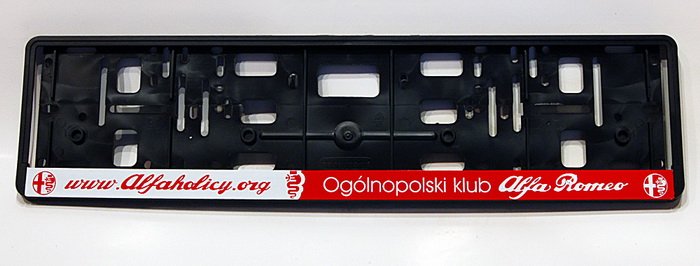
• Jeśli chcesz dodać swojej Alfie charakteru i jednocześnie zaznaczyć przynależność do naszej społeczności – to dobry moment, żeby je zamówić.

    Ramki Alfaholicy

    Szczegóły, zdjęcia oraz informacje o zamówieniu znajdziesz tutaj.

    Nie czekaj, bo jak zwykle schodzą szybko.

Collisions

A man riding a bicycle of the brand Romet failed to control the vehicle in a turn, oversteer caused by rear-wheel drive made him fall off the saddle and slide along the grass, colliding with innocent Giulia, pushing her into a ditch. In the background a tow truck is preparing to extract the man from under the vehicle.
Damn cyclists, they always do something stupid.
 
someone from the guys? Serious matter. It looks like the car drove under a truck.
DSC_6758.jpg
 
Judging by the fact that the tow truck is a car carrier and it’s loaded as well, it’s probably private import." Soon there will be a "new" and "unridden" one available for purchase.
 
Yes, Giulias are already leftovers and Stelvio are also flowing to the European scrapyards by the Vistula...
 
I would rather bet on a collision in the city. Photo from Warsaw, at the intersection of Czerniakowska Street / Siekierkowska Route, so it’s not a transit road through Warsaw. God knows.
 
probably both cars were going 120-150 km/h each (a 240-300 km/h speed difference) and it ended very badly. unfortunately when it comes to crush zones they are designed for a impact at 50 km/h into a fixed obstacle, not much higher speeds. I don’t know if this was the case here, but when I drive on two-lane roads I don’t like left-hand bends where they often install those vertical "louvres" blocking glare from the opposite lane - it’s hard to see if some kamikaze is driving against the traffic - due to those louvers there’s almost no time to react/leave the lane. About 20 years ago I had a similar moment when someone drove at me on the entrance to Bielsko-B near the end I managed to wedge myself between cars on the right lane.
Does anyone know whether the driver Stelvio maybe some forum colleague?

Regardless of whether it’s a forum colleague or not, a very unfortunate matter. I don’t know and probably we won’t learn whether it was Ford driver’s fault when entering, and whether at the moment he realized he was driving against the traffic and didn’t turn around (the internet is full of videos of people who knowingly continue driving against the traffic to the nearest exit, instead of pulling over, turning around when it’s safe possible). Shame, 2 people died, and the driver Stelvio had no fault of his own at all.
 
Last edited:
The speeds do not add up. This does not change the fact that at 140-150 km/h there are still zero chances. Here you can see that the cabin in Stelvio wasn’t mangled, but presumably the overpressure alone was enough.
 
I see a misunderstanding of the topic. Well yes, but this video material compares a hit into a wall of a car going 50mph with a head-on collision of two cars each going 50mph. The results are the same (damages/g-forces) and that's obvious, because each of these cars absorbs the same energy (half each), and that energy is again the same as in the case of hitting a stationary obstacle at 50mph (because all the kinetic energy is in the car). In both cases the cars decelerate to 0 from the same speed, in similar time and identical stopping distance, so there is no difference.

Regarding the speed difference that DOES appear (and please don't deny this because you deny simple physics and make fools of yourselves) let us discuss by comparing the same conditions, i.e., when you consider crashing a car going e.g. 300km/h into another parked car (0km/h) - this is exactly the same as if you crashed head-on two cars each going 150km/h.

Motion is a relative concept, and regardless of what reference frame you adopt, the conservation laws of energy/momentum hold and the effects are the same. If you don't believe, write down the formulas and plug in numbers. In a crash into a parked car don't forget to account for the fact that after the collision both cars gain a velocity equal to half of the impact velocity (momentum conservation) - these cars will stop a few hundred meters further on. Of course the analysis is simplified because I assume an inelastic, perfect crash, but in practice it won't differ much from that model.

Aside from that there is another issue. Cars are engineered for collisions with a fixed obstacle - here the crush zone works, prolonging the deceleration time and thus reducing g-forces (negative acceleration). The problem arises when that crush zone no longer exists - i.e., a crash at higher speed - there is some deceleration through the crush zone, but the car still has a ton of kinetic energy, reaches the cabin, and suddenly there is no crush zone, only something that barely yields and the car stops much more rapidly. At this moment the g-forces rise (the absolute value of acceleration jumps to a higher value), and this is the factor that causes body injuries/bone damage.

Conclusion.
A crash into a fixed obstacle that doesn't budge produces similar effects to a crash of vehicles (of equal mass and double the speed difference) with each other. What matters is the speed difference (I consider the same masses). In the case of different masses or speeds, you need to account for it. You can adjust for possible effects by considering the momenta and kinetic energies of both vehicles - you can recalculate, for example, to a car of the same mass but a different speed (that's why a crash into a small Fiat will cause much less effect on us than crashing into a truck despite the same speed difference).
Think this through.
 
Last edited:
Regarding the speed difference that DOES appear (and please don't deny this because you deny simple physics and make fools of yourselves) let us discuss by comparing the same conditions, i.e., when you consider crashing a car going e.g. 300km/h into another parked car (0km/h) - this is exactly the same as if you crashed head-on two cars each going 150km/h.

Assuming two equal masses you cannot sum speeds in a head-on collision, the crush zone is also twice as large. Notice that with equal masses you have effectively two hits into the wall. With mass disparity you can theoretically transfer some speed to one side but it still isn't a sum.

There was a time when Top Gear talked about this. MythBusters as well.

The simplest way to imagine this is as follows: Two cars collide head-on with the exception that they crash into the wall on both sides.

To sum it up you would have to crash head-on a car and a train (or something of comparable mass).
 
Last edited:
Assuming two equal masses you cannot sum speeds in a head-on collision, the crush zone is also twice as large. Notice that with equal masses you have effectively two hits into the wall. With mass disparity you can theoretically transfer some speed to one side but it still isn't a sum.

There was a time when Top Gear talked about this. MythBusters as well.

The simplest way to imagine this is as follows: Two cars collide head-on with the exception that they crash into the wall on both sides.

To sum it up you would have to crash head-on a car and a train (or something of comparable mass).

On one hand, a lot of what you wrote is true, on the other hand you probably didn’t read my post carefully and you’re also wrong about adding speeds. What I wrote exactly matches the Mythbusters video linked here. You’re just getting lost in understanding what I’m writing.

Yes, a crash of vehicles traveling e.g. each at 50km/h into each other is equivalent to the effects of hitting a wall at 50km/h - I wrote that and explained it.

What you don’t get is that speeds do add up in a head-on collision of vehicles (same masses) e.g., if they have a speed difference of 100km/h that will produce exactly the same effects/injuries/damage to the vehicles. It doesn’t matter if one goes 20 and the other 80, or both go 50, or one is stationary and the other hits it at 100km/h. It’s the speed difference that matters. That’s what I’m writing about, and here they add up. Just compare head-on collisions of vehicles with the same mass, where part of the momentum is transferred to the other body (the folded sheet of metal/mass) than to the case of hitting a stationary obstacle which does not budge (tied to the Earth’s mass and has huge inertia) - because then all the energy is absorbed by the striking car.

Regarding the summing of crush zone energies, yes, everything lines up, which is why half of the kinetic energy is dissipated in one car and half in the other, and why hitting 50km/h into a wall is equivalent to a front-on collision of two vehicles of the same mass traveling with a speed difference of 100km/h - each will take half the energy. If you want to calculate this with formulas/numbers, don’t forget about the remaining momentum of the system (in the case of different momenta of the two vehicles) - because the system after the collision may have nonzero momentum (e.g., the same masses but different speeds). In collisions at the same speeds (same masses) the post-collision momentum is zero (the cars stay at the collision point and don’t one push the other away), so don’t confuse yourself/ignore it.

I suggest thinking again and understanding where your thinking goes wrong.
 
This is not a sum. Even assuming you crash into an immovable wall of the same mass as the car, moving toward you at the same speed, it still has its own inertia and will also absorb its share of the energy from the impact simply by removing its momentum.
The fact that the car deforms and the wall stays intact does not mean the wall absorbed less energy. It absorbed exactly the same amount as the car.
 
I don’t agree.

Maybe I had physics more than 20 years ago in high school and just a semester in college, but I was always good at it, so I’ll allow myself to argue a bit more.
Tomtrz, using plain common sense, let’s consider another example. An indestructible wall is something that has zero crumple zone; let’s think what happens in the opposite case. Imagine that a huge block of soft, but inelastic foam with very large dimensions is rushing toward you, something that yields very easily, but has a mass equal to the car. that is, such a mega crumple zone - very deep and with very little resistance (and inelastic, because collisions are closer to inelastic). It collides with the car under the same conditions you describe. What happens? Well, the car flies into that crumple zone and loses energy over a very long distance (let’s go crazy: hundreds or even thousands of meters it drains into the foam mass), i.e., over a very long time. The car is not destroyed, and inside, people are fine. The car stops, the foam mass also stops (the momentum conservation principle here is m1*v1=m2*v2 since we assumed m1=m2 and v1=v2). The car took on a minimal part of the energy and that over a long time; the resistance force it offered was very small, almost no g-forces inside the car. And what about the foam? It stopped calmly but with a hole hundreds of meters long it absorbed all the kinetic energy of the car and its own energy for deformation. Who suffered more in this collision? The foam, because it absorbed all the kinetic energy of the car and its own for deformation.

The collision of an indestructible block with a car will be such that this time the role of the foam is taken over by the car, and it is the car that takes on all the kinetic energy of both.

I leave it for you to think about.

Another thing. there is no difference whether this car crashes into another parked car at 100 km/h or both cars move toward each other at 50 km/h, or one goes 20 and the other 80 toward each other. Motion is a relative concept and whatever you describe with equations from any other reference point - another car moving parallel, or a fixed point on the road, or the Sun - all momentum and energy conservation rules will agree if you lay out the equations nicely. However, you must predict which moving object will take what part of the energy for deformation. The wall scenario changes this balance.

Of course I’m talking about car damage. The crumple zones themselves cause this energy transfer, and the acceleration (negative, i.e., deceleration) is smaller, and thus the passengers are subjected to smaller forces and suffer less injuries (the time over which energy is transferred lengthens, i.e., the impact power is lower).

In real cars we have a crumple zone and here it works nicely, unfortunately it ends at the front windshield and then we have a much stronger cabin structure, and the deceleration (power/deceleration/forces, etc.) increases. Cars are designed to collide with a stationary indestructible block at 50 km/h—that’s how they are tested in NCAP as far as I know. Let’s suppose that this is equivalent to hitting another car at a 100 km/h difference. Unfortunately, at higher speeds the crumple zones disappear and it’s a slaughter. And such a situation occurred in a head-on collision on the highway—that difference was probably much more than 200 km/h, if not 300.

Okay, I’ve written my bit, I’m repeating myself and others do too.

P.S. My arguments exactly align with what was shown, for example, in Mythbusters (and I also wrote about it here, with references to Mythbusters; I’ll skip those to Top Gear), only I see that some people didn’t quite read what I wrote, and others try to prove something else.
 
The collision of an indestructible block with a car will be such that this time the foam plays the role, and it is the car that takes on all the kinetic energy of both.

you don’t understand at all, because you focus on the crumple zones, the destructions, which are basically only a side effect of losing speed. The car’s structure cannot withstand such g-forces.

You can imagine that the car stops by itself, simply because it has such good brakes from 100 km/h in a fraction of a second, without hitting anything. It would break into pieces.

Just like the passenger buckled in the seat belt. After all, nothing hits him, and yet they had internal injuries. The fact that the wall doesn’t get damaged doesn’t mean it didn’t absorb any energy. But what stopped a moving wall, if not kinetic energy? The difference is that the indestructible wall could absorb that energy without damage. The car not so much.

If two bodies of the same mass move at the same speed and suddenly lose it to zero, the same force acted on both.

And in your foam example, it will be exactly the same. Well, since the foam and the car with the same momentum x reduce that momentum to 0, the same amount of energy had to be put into the process on both sides. It will stretch in time, so the forces on the car won’t be as high as in the case of hitting a wall :D
 
Last edited:
Welcome to the University of the Third Age. Today’s physics lesson — collisions in land traffic. The main topic — a head-on collision of two cars moving in opposite directions at 100 km/h each is not the same as hitting a car moving at 200 km/h into another, stationary car. Why? That’s your homework. Thank you for your attention. Tomorrow we’ll discuss the paradox of infinite force versus an object of infinite mass, whose life-like example we know as Chuck Norris punching his own chin. Goodbye.
 
Tomtrz. my turn, and my statements are being paraphrased mainly by you - or what I wrote is given to me by you or others as if your statement is supposed to make me realize something? it’s hard to discuss like that. And those giggles at the end, what for, the method of discrediting with half-smiles? I demand better


Is it really hard to understand that motion or speed or momentum or kinetic energy is a relative concept? And you just shouldn’t mix a two-car collision with hitting a wall mounted to the ground and when considering the effects you have to account for how energy was dissipated? You’re again repeating mine and pushing something else as if I wrote something else.

Returning to what this started from - if two cars speed toward each other at 150 km/h each, it’s generally f—ed. And that’s because there’s a big difference in speed, because speeds add up, and there’s nothing to be gained as an effect!

No comment... anAlfaBeta, I’m only in the 2nd century :)
 
Amortyzatory
Back
Top