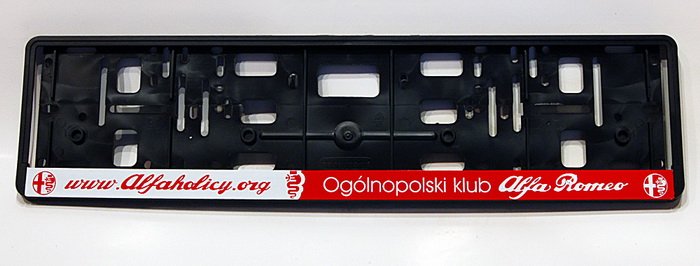
• Jeśli chcesz dodać swojej Alfie charakteru i jednocześnie zaznaczyć przynależność do naszej społeczności – to dobry moment, żeby je zamówić.

    Ramki Alfaholicy

    Szczegóły, zdjęcia oraz informacje o zamówieniu znajdziesz tutaj.

    Nie czekaj, bo jak zwykle schodzą szybko.

System Start & Stop

not interesting what are the reasons for not switching off the engine
my engine cut off after a hard drive of the car :D so the operation of this system is a mystery to me

There are a lot of variables that affect the deactivation of this system, so I wouldn’t worry too much if someone’s car doesn’t go out. It would be worse if it wouldn’t light up. :D

---------- Post added at 23:53 ---------- The preceding post was written at 23:51 ----------

But it’s good because today it shut off on me when starting and after pressing the clutch it started again on its own.

Oh, that’s true, that’s what S&S is good for. Twice in a month I stalled the car because I wanted to move before the engine had fully warmed up after starting... So the system solves a problem! Which it had previously created.
 
disable this stupid start & stop. It does nothing, and it will eventually ruin your turbo. There are no miracles: a turbo, when warmed up, CANNOT be turned off and on in this way. This way you’ll save a few bucks on fuel but later you’ll spend a few thousand on a turbo whose life will be shortened by at least half.
 
but who told you that the system will switch off the engine after a sharp drive when the turbine needs a break?
 
I assume, perhaps naively, that someone did think this system through and it won’t harm the engine, especially since friends say it activates quite rarely. For me it activates often enough that I sometimes actually deactivate it, or hold the clutch. Besides, once it’s on, I try to press the clutch before the yellow [warning], because you can’t move smoothly if you press the clutch with the yellow light on. (Smooth start for this argument means exactly the moment the green lights up).

I’m learning to live with it, for now.
 
Worse, if someone thought that two years would be enough for the turbine and then you’re on your own. I use S&S in the city when there’s a chance for normal stop-to-stop driving. If I see I’ll be crawling in traffic repeatedly I switch it off. If I feel like pushing a bit on the highway I also switch it off - just in case and I don’t find it particularly annoying.
 
but who told you that the system will shut off the engine after aggressive driving when the turbo needs a break?

is there any relation then? meaning, when the turbo is hot, does the system not activate? No, there is no such relation. Besides, this isn’t about the engine after aggressive driving, strictly speaking about obeying the rule of not switching off the engine with the turbo immediately.
 
i drive a car with a turbo, nothing to wait for after a trip - you simply just shouldn’t stomp on it during the last few hundred meters.

as for the S&S system - for it to work a whole set of conditions must be met - do you think introducing this contraption into use is intentional sabotage and an attack on the turbo lives? ;) many companies use this system for many years and nowhere has it been heard that in an unfavorable way it affects the crank or turbo life. therefore it’s not worth believing in superstitions and repeating like unsubstantiated urban legends ... you have to go with progress :)
 
meaning, when the turbo is hot, does the system not work? No, there is no such dependency.

Yes, there is. I already wrote here that once I drove 16 km in the city the way Alf should be driven and the engine first turned off only when parking. Other factors could also come into play, such as low external temperature, but I definitely notice that with dynamic driving the system engages much less often.
 
I am firmly convinced that the computer estimates consumption over the last kilometers driven and the RPMs and based on that decides whether it can turn off the engine or not.
 
I am firmly convinced that the computer estimates fuel consumption over the segment of the most recently driven kilometers and RPMs, and on that basis determines whether it can switch off the engine or not.

Darn, and you know I didn’t think of it, that actually when I drive economically now through villages and rarely in traffic jams, perhaps that’s why it doesn’t turn off my engine. I’ll do a few stops tomorrow, something like at lights.
 
I’m also learning to live with S&S. At first I didn’t like it, but now I’ve gotten used to it and it’s basically okay. It has its downsides: - engine start delay; when I’m first at the lights I deactivate it because I don’t want to seem lacking in reflexes, - in this weather it can behave oddly, turning off the engine for a few, several seconds, then starting by itself without my intervention. It’s a rather stupid sensation. I think under certain borderline conditions it shouldn’t turn off the engine, rather than starting again after a few moments of contemplation. - the message on the computer S&S unavailable is quite misleading, at least initially. Now I know it’s about conditions that prevent its operation, not that it’s broken. Then maybe it will display broken :)
- and in traffic you can’t drive on it.
 
I drive a car with a turbo, nothing to wait after a trip - you simply shouldn’t stomp on it during the last few hundred meters.

:)
 
This is what awaits you soon: turbo failure and its replacement, very expensive. This is technical alphabet; it’s worth knowing how the turbo works.

You’re telling fairy tales about cushions and repeating urban legends. Please drop some results backed by technical studies, otherwise we have nothing to discuss :D

PS. Even if it fails at 100k km, what do I care... let the one who will drive it worry.
 
This is what awaits you soon: turbo failure and its replacement, very expensive. This is technical alphabet; it’s worth knowing how the turbo works.
 
I would like to gently point out that indeed it never hurts to keep the last few seconds of turbine operation at low revs, but technology is moving forward and more and more common are additional oil/water pumps that ensure proper cooling of the turbine after engine shutdown. So I would refrain from such a sharp comment.

I have such a system in another car - a Renault 2.2dCi.

I would also note that some people go to the other extreme - leave the engine running for several/few dozen minutes. No-one asks for unnecessary engine operation, for various reasons from ecological to lubrication matters.

Returning to S&S, this invention cannot really be considered new; if I remember correctly it’s available for 7-8 years. Long enough to avoid childhood illnesses...

If I had to fear something in my Julcia, it would be the aluminum suspension first, and in second place a 1.4 giving 170HP... Not just advantages of a modern four-cylinder, but time will tell if durability will be as rosy. I already see how for the serial production they use forged pistons, connecting rods and a whole mass of other components used in racing. If memory serves me right, even five years ago extracting ~200HP from a 1.4 was possible only in racing, and that with life measured in hours...

I would like to gently point out that indeed it never hurts to keep the last few seconds of turbo operation at low RPMs, but technology keeps advancing and more and more common are additional oil/wuel pumps that ensure proper cooling of the turbo after the engine is turned off. So I would refrain from such sharp commenting.

I have such a system in another car - 2.2 dCi by Renault.

I would like to note, however, that some people overdo it the other way - they leave the engine running for quite a few/ten minutes. Unnecessary engine operation isn’t assigned by probably all engine manufacturers, and for various reasons, from ecological concerns to lubrication matters.

And returning to S&S, this invention cannot really be classified as a novelty of recent years; if my memory serves, it has been available for 7-8 years. Long enough to avoid childhood illnesses...

If I had to fear something in my Julka, it would definitely be the aluminum suspension first, and second the 1.4 delivering 170 HP... On paper, the virtues of a small-displacement four-cylinder seem many, but time will tell whether durability will also be as rosy. I already see how for serial production they use forged pistons, connecting rods and a whole mass of other components used in motorsport. If my memory serves, just five years ago extracting ~200 HP from a 1.4 was possible only in motorsport, and at a lifespan measured in hours...
 
I’ll keep it short: if these turbo engines were delicate they wouldn’t be offered standard to the masses, that’s first thing!

But there is a small nuance, and I hope it’s just a nuance: namely the 2-year warranty is a joke given 7 years on the car (KIA).

My personal digression, in two years the engine will be bought for 3k PLN,
so even if the turbo costs 500 PLN it’s a pittance.

One side of the suspension: bush/ball joint costs more.

PS: they moved forward now because in the lower control arm they made a supposedly replaceable ball joint, only pity that instead of screws they used steel rivets.
 
I’ll keep it short: if these turbo engines were delicate they wouldn’t be offered standard to the masses, that’s first thing!

But there is a small nuance, and I hope it’s just a nuance: namely the 2-year warranty is a joke given 7 years on the car (KIA).

Hmm, somehow that doesn’t cheer me up; it’s enough that they gave 3 years of durability, and then... After all, service is where they make the most money... I’m writing three, because this brand has a bit more respect for its customers than, for example, Renault, where turbine life was calculated to the limit, parts usually died after 2 years, so about 60k km :)
And with Kia it isn’t so sweet; sure the first 3 years are full warranty, later it doesn’t differ much from widely available extended warranty offers (insurance).

Generally, among mechanics, the concept of downsizing triggers lively discussion. Wherever you push the material strength limits in mass production, and thus a certain intended tolerance bands must cause problems. Don’t kid yourself, this isn’t short-series production of some craft, but mass market, with all the supplier infrastructure.

PS: they moved forward now because in the lower control arm they made a supposedly replaceable ball joint, only pity that instead of screws they used steel rivets.

That’s not a problem, in the Laguna I had the same, the new bush is attached with screws, and in the old one they cut notes, 5 minutes of work...
 
That’s not a problem, in the Laguna I had the same, the new bush is attached with screws, and in the old one they cut notes, 5 minutes of work...

Cutting or drilling isn’t the issue, but that wasn’t what I meant. If they make a suspension arm with a theoretically separable ball joint, then why the hell make it riveted. It would be cheaper and Alfisti would see a bit more benefit.

And now, on a different note, something like a joke, a jab at these supposedly unreliable Italian cars.
Before I bought a Giulietta I had a 147, I live in Silesia, lots of people and supposedly lots of Alfas that are always in the shop. My 147 was 10 years old, thinking of selling, I go to a local mechanic to do the front suspension because it has 100k miles on it and I could use at least bushings/ball joints. And about my visit, the guy goes :) man, I’ve never worked on such a car, it’s still new, why not go to the ASO.
I told him that it’s already 10 years old and I wanted to do the suspension cheaper.
He surprised, sure we’ll manage but first time I do such a car because I usually worked on VW/Audi :) I hope you understood my jab.
 
Last edited:
No jab, that’s true, there are hundreds of parts shops for VW/Opla in Wrocław, but Italian ones are three or four.
 
Today I picked up Giulietta (wrapped in red paper), with a bottle of champagne. The salesman said that S&S won’t work for the first several hundred km because it needs to calibrate. And look, it works after the first 2 kilometers. With rear window heater on, no, but that’s black on white in the manual (which I’m studying now). A few first cycles of turning off I simply didn’t notice. Engine starts within a second when I press the clutch to engage first.

And about the warranty – in Germany you can extend for 3 more years (totalling 5 years) for 300 euro/year, at any time within the first 2 years. Is there an option like this in PL? And is it worth it?
 
Last edited:
Amortyzatory
Back
Top